What to Do If a Client Refuses to Sign Your Consent Form
The client is already on the bed.
Their coat is off. Their phone is face down. You are five minutes behind.
Then they look at the consent form and say, “I don’t really want to sign this.”
There is a very specific kind of silence that happens after that.
You do not want to seem dramatic. You do not want to lose the booking. You definitely do not want to get into a legal-sounding argument while your next client is due soon.
But you also cannot just shrug and carry on.
A consent form is not decoration. It is the bit where the client confirms they understand what is being done, what information they have shared, and what they are agreeing to before treatment starts.
In formal healthcare settings, consent is tied to permission given after an explanation of the treatment, and data consent rules also expect consent to be clear, informed, and affirmative. Your beauty business may not be a hospital, but the principle is still useful: no clear consent, no comfortable green light.
So what do you do when someone refuses?
You slow the moment down.
First, do not make it personal
A client refusing to sign does not always mean they are trying to be difficult.
Sometimes they are embarrassed because they do not understand a question.
Sometimes they are worried the form gives away too much.
Sometimes they have had a bad experience with hidden terms, medical paperwork, or businesses using their details for marketing.
And sometimes, yes, they want the treatment without accepting any responsibility for the information they provide.
You do not need to guess which one it is.
Start calmly:
“No problem. Can I ask what part you are unsure about?”
That sentence does a lot.
It keeps your tone professional. It gives them room to explain. And it stops you from jumping straight into defence mode.
Their answer tells you what happens next.
Find out what they are actually refusing
“Consent form” can mean a few different things.
They might be refusing:
The whole form
One medical question
A photo or media release
A cancellation policy
A patch test confirmation
A marketing opt-in
A data storage statement
A specific risk acknowledgement
These are not all the same.
A client declining to let you post their brow lamination photos is not the same as a client refusing to confirm allergy information before tinting.
So separate the essentials from the optional extras.
For example, treatment consent and relevant medical history are usually essential to whether you can safely provide the service. A marketing opt-in or public photo permission should be separate and optional.
That separation matters. UK GDPR guidance, for example, expects consent to be specific and unambiguous, with clear records kept where consent is relied on.
In plain salon language: do not hide five different permissions inside one scary block of text.
It makes clients suspicious.
And honestly, fair enough.
Explain the form like a human, not a courtroom
Here is where people usually screw it up.
They say, “It’s just policy.”
That may be true, but it does not help.
Try this instead:
“This form is here so I know about anything that could affect your treatment, like allergies, medication, sensitivities, or previous reactions. It also confirms we have talked through the treatment before I start.”
That feels different.
You are not waving a rule at them. You are explaining the reason.
For a lash treatment, you might say:
“I need this signed because we are working close to your eyes, and I need a record of any sensitivities or previous reactions before I apply product.”
For PMU:
“I cannot go ahead without a signed consent and medical history because this treatment breaks the skin and needs proper records.”
For nails:
“I need to know about allergies, lifting, nail damage, or reactions, especially if we are using gel or builder products.”
For facials:
“This helps me avoid ingredients or techniques that may not suit your skin, medication, or recent treatments.”
Simple. Specific. Calm.
No lecture.
If they still refuse, do not perform the treatment
This is the uncomfortable part.
If the form is essential to the treatment and the client refuses to sign it, the safest answer is no treatment today.
Not because you are being cold.
Because you cannot responsibly provide a service while missing the agreement or information you need.
You can say:
“I completely respect that you do not want to sign it. I’m not comfortable carrying out the treatment without completed consent, so we will need to pause today.”
That is enough.
Do not over-explain until it gets messy.
Do not bargain.
Do not say, “Fine, just this once.”
That phrase has caused so many avoidable problems in beauty businesses.
Just this once becomes the one appointment where the client later says they were not warned, did not understand, never agreed, or told you something verbally that nobody wrote down.
Document the refusal
If a client refuses to sign, make a note.
Not an emotional note.
Not “client was rude.”
A clean factual note.
Something like:
“Client attended appointment on 12 May. Consent form was provided before treatment. Client declined to sign section relating to treatment risks and medical confirmation. Treatment was not carried out. Client was advised they may rebook if consent is completed.”
If there was a conversation, include the basics: what was explained, what they refused, whether questions were answered, and what decision was made. Risk management guidance often stresses documenting consent or refusal discussions clearly, including what was discussed and who was present.
This is not about being paranoid.
It is about not relying on memory three months later when the details are fuzzy and your diary has eaten your brain.
Do not let paper make the moment worse
Paper forms have a talent for making awkward moments more awkward.
The client is squinting at tiny text. You are hunting for a pen. They ask what a section means. Someone else is waiting. The form gets half-filled, crossed out, or left on the side.
Digital forms make this cleaner.
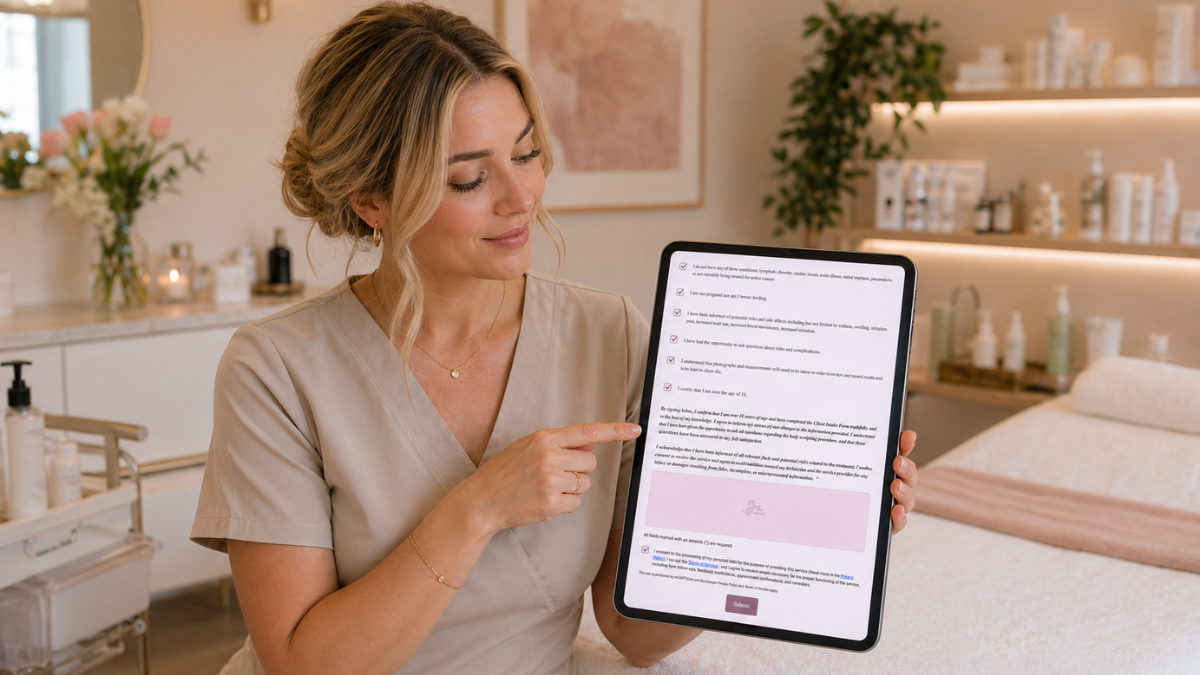
Glow Forms is built for beauty professionals who need branded, mobile-friendly intake, consent, consultation, medical history, and treatment record forms. Forms can be shared by email, link, QR code, or website button, and completed records are stored digitally in a searchable client database.
That helps because a client can read the form before they arrive.
No pressure. No rushed clipboard moment. No “I’ll just sign whatever” energy.
And if they do have a question, you find out before they are lying on the treatment bed with numbing cream scheduled and your day already running tight.
Watch for the red flags
Some refusals are simple confusion.
Others are warning signs.
Be careful if a client:
Says, “I trust you, so I do not need to sign”
Refuses to answer allergy or medication questions
Wants to cross out risk sections but still have the treatment
Says they had a previous reaction but will not give details
Gets angry when you explain consent is required
Tries to rush you with “I’m in a hurry”
Says another salon never made them sign anything
Wants treatment for someone else but cannot provide the right consent
That last one can get especially messy with younger clients, treatments involving higher risk, or anything where local rules, insurance, or professional guidance matter.
When in doubt, pause.
You can always rebook.
You cannot un-do a treatment that should not have happened.
Check whether your form is part of the problem
Sometimes the client is not the problem.
The form is.
If several clients hesitate, ask questions, or seem uncomfortable, your form may be too long, too vague, or too legal-sounding.
Look for phrases that sound like they were copied from a different industry.
Look for questions you no longer need.
Look for bundled permissions that should be separate.
Look for optional things that feel mandatory.
A good consent form should be clear enough that a normal tired client can understand it on their phone after work.
It should say what the treatment is, what the client needs to disclose, what risks or aftercare points matter, and what they are agreeing to.
Not 900 words of fog.
You are not trying to scare them into signing.
You are trying to help them make a clear decision.
Have one calm script ready
You do not want to invent your wording while the client is staring at you.
Use something like this:
“I understand if you are not comfortable signing. This form is required before I carry out the treatment because it confirms we have covered the key information and that you have shared anything relevant, like allergies or medical details. If you do not want to complete it, I will not be able to do the treatment today, but we can pause here and you can decide whether you want to rebook later.”
That is professional.
It gives them a choice.
It protects your boundary.
And it avoids the weird power struggle where you try to convince someone to sign something they do not want to sign.
Because that is not consent either.
The real rule is simple
A client is allowed to refuse.
And you are allowed to refuse to treat without the consent you need.
That is the cleanest version of the boundary.
No drama. No guilt. No “but I already mixed the tint.”
Just a calm pause, a clear explanation, and a proper record of what happened.
The best beauty businesses do not treat consent forms like annoying admin.
They treat them like part of the appointment.
Because they are.