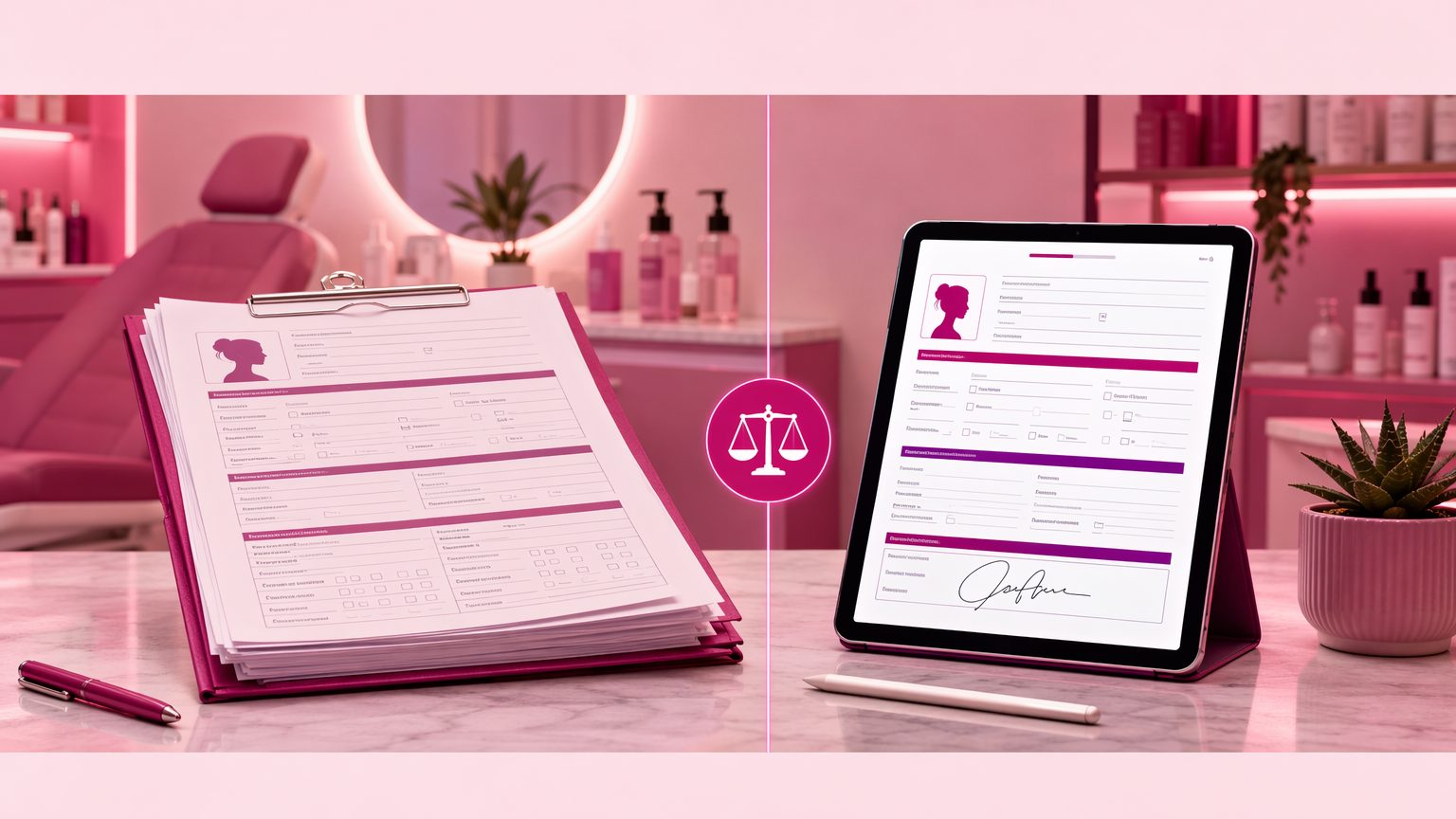
Paper vs Digital Intake Forms for Salons and Med Spas: What Actually Changes Day to Day
7 min read
On a busy morning, the difference between paper vs digital intake forms shows up fast. A client walks in, someone is looking for a clipboard, the phone is ringing, and the front desk is trying to keep appointments moving. That is why this comparison matters less as a tech debate and more as a day-to-day workflow question. For salons and med spas, the real changes show up in check-in, staff workload, signatures, record access, updates, and the overall client experience. The right setup depends on your service flow, team size, and how often client records need to be updated.
With paper salon intake forms or med spa intake forms, the routine is familiar. You print forms, hand them to the client, answer questions, collect signatures, then file everything away. It works, but it also creates small delays all day long.
Clients often fill forms out in the lobby right before their appointment. That means rushed answers, skipped questions, and handwriting that is hard to read later. A signature might be missing. A medical history section might be left blank. A provider may not notice until the client is already in the room.
Paper also pushes review later in the process. Instead of seeing the information ahead of time, staff often scan it only when the service is about to start. Then someone has to clarify allergies, confirm photo consent, or ask the client to finish a missing section.
After that comes storage. Filing, sorting, and finding old forms becomes its own recurring task, especially once a client returns months later and needs an update.
The biggest shift with digital intake forms for salons is timing. Instead of waiting until check-in, you can send forms before the visit so clients complete them on their phone at home, in the car, or whenever they have a quiet minute.
That changes the feel of the appointment before it even starts. Clients have more time to read questions carefully, enter history, and sign without feeling rushed at the front desk. This matters when consultation details affect the service, like sensitivities before a facial, health history before a med spa treatment, or patch-test information for brow or lash services.
With paperless client intake, your team can also review submissions ahead of time. If something is missing, you can catch it before the client arrives instead of during the appointment slot. That makes arrivals smoother and timing more predictable.
This is where the day-to-day difference is easiest to feel. Paper check-in usually means clipboards, pens, handoffs, scanning, filing, or chasing missing signatures. A digital process removes many of those small steps.
That matters because front desk work is rarely just front desk work. The same person may be answering calls, greeting walk-ins, handling payments, and turning over rooms. Even in businesses without a dedicated receptionist, someone is still doing that coordination.
Mobile-friendly intake forms reduce bottlenecks, but the real win is not only speed. It is fewer interruptions. Fewer moments where someone has to stop what they are doing to print a new form, answer a repeated paperwork question, or move paper from one person to another.
Typed information is simply easier to work with than handwriting. When clients complete beauty client intake forms digitally, answers are usually clearer and more consistent.
Structured forms can also help reduce incomplete submissions. Required fields make it less likely that an allergy section, consent checkbox, or emergency contact gets skipped. That does not replace judgment, and it does not guarantee anything legally, but it does support clearer records and better communication.
For beauty and wellness businesses, that matters. Allergies, sensitivities, contraindications, service preferences, and consent details are not small details. Cleaner records help your staff feel more prepared before a service starts and reduce back-and-forth once the client is already in the chair or treatment room.
Consent is rarely one-and-done. Services change. Policies change. Clients come back for new treatments. Minors may need guardian signatures. Photo consent choices may be updated.
With paper, those changes often create version-control problems. Which form did the client sign? Was it the latest one? When was it completed?
Digital workflows make it easier to resend updated forms and collect new signatures when appropriate. That is especially useful for annual updates, new service categories, or digital consent forms for med spas that need to be refreshed over time. The practical benefit is consistency: your team can more easily see what was signed and when, without relying on stacks of older paperwork.
One of the biggest costs of paper does not show up at check-in. It shows up later.
A returning client mentions a past reaction. Someone needs to confirm what was noted last time. With paper, that may mean searching folders, cabinets, or scanned files with inconsistent names. During a busy day, that slows everything down.
With searchable salon client records, the process is much simpler. You can pull up a client history quickly before or during the appointment. That helps with repeat visits, follow-up questions, rebookings, and team handoffs.
This matters even more in small teams, where more than one person may need access to the same information. Good record access is not just about storage. It affects how confidently and smoothly your team can work.
Clients usually do not get excited about paperwork, but they do notice when the process feels easy. Many prefer filling out forms on their phone instead of arriving early to write on a clipboard in a waiting area.
That convenience can make your business feel more polished, organized, and current. It also gives clients a better chance to provide accurate information because they are not rushing through forms in a lobby.
For a high-volume salon, that can mean faster arrivals and less friction. For a med spa, it can support a more thoughtful consultation process. In both settings, the client experience improves when intake feels simple and professional.
Paper still feels comfortable for a reason. It is familiar. It seems simple. If client volume is very low or services are very basic, it may feel workable.
There are also real transition concerns. Setting up new forms takes time. Staff need to learn a new process. Front-desk routines may need to change. Those are valid considerations.
But the better question is not whether paper is possible. It is which system creates less friction in your actual workday.
Before moving to client intake software for salons, map your current process from booking to check-in to treatment room.
Ask:
These questions help you compare paper vs digital intake forms based on real workflow, not guesswork.
When salons and med spas switch from paper to digital intake, the biggest changes are practical. Clients can complete forms earlier. Check-in gets smoother. Records are easier to read, update, and find. Staff deal with fewer interruptions. The whole business feels more organized.
That is the real value of digital intake: not just going paperless, but making the day run better. If you want a simple way to create mobile-friendly intake forms, collect signatures, and keep client records organized in one searchable place, you can try GlowForms.
Loyal clients do not stay because you are the cheapest. They stay when the experience feels consistent, personal, professional, and worth coming back for.
GlowForms reminders aren’t “don’t forget your appointment” nags. They’re polite nudges to finish intake forms before clients arrive—so you start on time and sta

Booking a minor? Use a parent/guardian signature, ID check, and service-specific consent with aftercare. Here’s a clean setup that keeps records tight and safe.