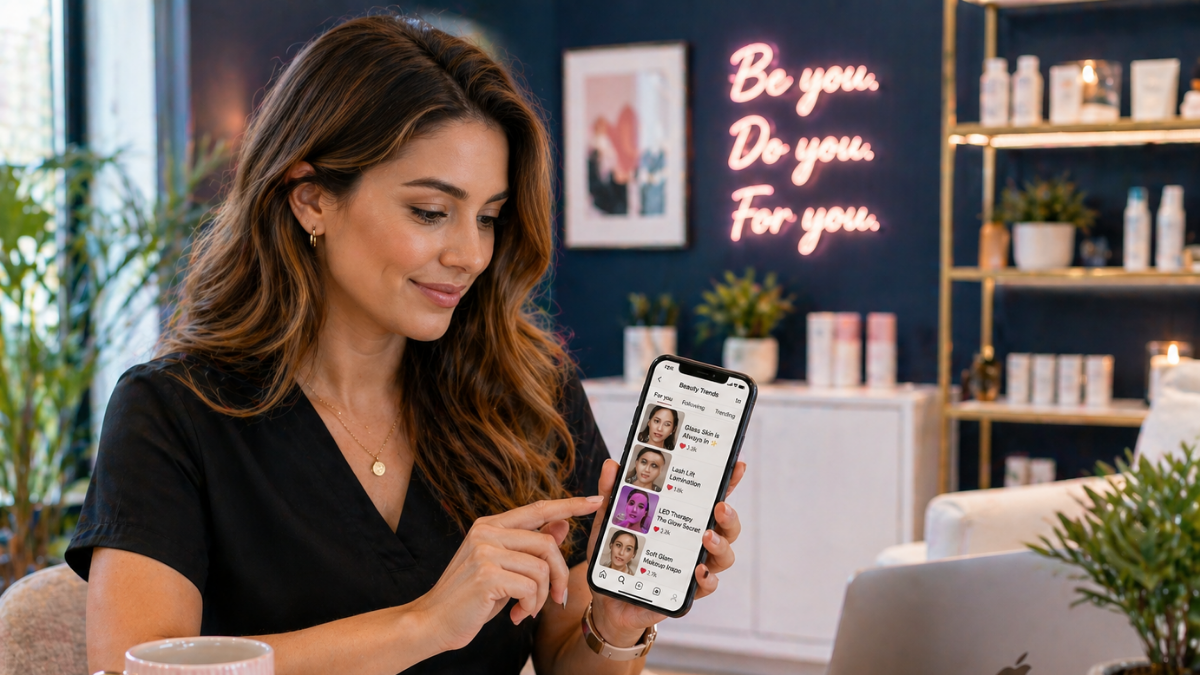
How to Spot a Trend Before It Goes Viral
6 min read
A client sits down and says, “Have you heard of that Korean glass skin facial thing?”
Then another client asks the same question two days later.
Then someone messages you a blurry TikTok and says, “Can you do this?”
That is the moment.
Not when the trend is everywhere. Not when every salon in your town has already posted the same reel with the same trending audio.
The useful moment is earlier, when a trend is still a little messy, a little niche, and not fully named yet.
That is where smart beauty professionals pay attention.
Because spotting a trend early does not mean chasing every shiny thing online. It means noticing what your clients are already becoming curious about before they have the language to ask for it properly.
Most trends do not start as clean service requests.
They start as slightly awkward questions.
“Do you do that brow thing where it looks laminated but not too much?”
“Can I get nails like that clean girl style but still with a bit of chrome?”
“Is there a facial for when my skin looks tired but I don’t want anything intense?”
That is not noise. That is data.
One question might be random. Three similar questions in one week is worth writing down.
The mistake is waiting until clients use the exact treatment name. By then, they have probably already seen five other people talk about it.
Pay attention to the shape of the request instead:
What result are they asking for?
What words do they keep using?
Are they showing you similar photos?
Are they asking because they want it, or because they are nervous about it?
Does the request fit your services, or would it need training, patch testing, or new consent wording?
That last part matters.
A trend is not just a marketing opportunity. It can also change the questions you need to ask before treatment.
Big beauty accounts are usually not early.
They are loud.
By the time a trend hits the biggest pages, the idea has often been tested, copied, renamed, and repackaged several times.
The earlier signals usually come from smaller creators, working artists, niche educators, and clients posting tiny details from their own routines.
Look for patterns like:
A new phrase appearing in captions
The same finish showing up in different cities
Clients saving similar inspiration photos
Educators suddenly teaching one technique more often
Product names appearing again and again in comments
People asking “what is this called?” under videos
That last one is gold.
When people want something but do not know the name yet, the trend is still forming.
You do not need to spend three hours scrolling. Just get better at noticing repetition.
If you are a nail tech and you see “soap nails,” “milky builder,” and “barely-there chrome” popping up in different places, do not immediately overhaul your service menu. But maybe start a note called “soft clean nail trend” and track what clients bring in.
Not glamorous.
Very useful.
Here’s where people usually get tricked.
A trend can get millions of views and still be useless for your business.
Maybe it looks amazing on camera but takes too long. Maybe your clients admire it but never book it. Maybe it only works for a tiny skin type, nail length, brow shape, or budget.
So do not just ask, “Is this viral?”
Ask, “Are my clients trying to buy this?”
That means tracking real behaviour:
DMs asking about the treatment
Consultation notes
Waitlist requests
Patch test enquiries
Booking form answers
Photos clients bring to appointments
Questions clients ask while already in the chair
This is where your forms can quietly become trend radar.
Glow Forms is built for beauty professionals who want branded, mobile-friendly digital forms for intake, consent, consultation, treatment records, and client details, with completed forms stored digitally in a searchable client database.
That is helpful because the clues are not always in your Instagram analytics.
Sometimes they are buried in answers like:
“I’m interested in skin boosters but nervous about downtime.”
“I want lashes that look natural, not heavy.”
“I saw a facial massage treatment online and wondered if you offer it.”
Those little answers tell you what people are warming up to.
And because they are coming from your actual clients, they are more useful than a random viral post from someone on another continent with a different audience, different pricing, and different regulations.
A trend is usually just a new outfit for an old desire.
Glass skin is not really about glass. It is about looking healthy, hydrated, and expensive without heavy makeup.
Clean girl nails are not really about being clean. They are about looking polished with low effort.
Lash lifts got popular because plenty of clients wanted visible lashes without the maintenance of extensions.
When you understand the desire underneath, you can decide whether the trend belongs in your business.
Ask yourself:
“What is the client really asking for here?”
More confidence?
Less maintenance?
A softer look?
A faster appointment?
A treatment that photographs well?
A result that feels expensive but not obvious?
That question saves you from copying trends blindly.
Maybe you do not need to add the exact viral treatment. Maybe you need to rename an existing service, update your consultation questions, create a seasonal package, or explain the result better.
Sometimes the trend is not a new service.
Sometimes it is a new way clients describe something you already do.
Please do not build a full campaign around a trend after seeing two TikToks.
Test it first.
A simple way:
Pick five regular clients who are a good fit. Ask if they have noticed the trend. See what they say. Offer a soft version if it suits your work and your insurance, training, and safety requirements.
You can also add one question to your consultation or waitlist form:
“Are there any treatments, styles, or results you have been seeing online that you are curious about?”
That question is beautifully nosy in the best way.
It gives clients permission to tell you what is already influencing them.
Then watch the answers for a few weeks.
If nobody mentions the trend, maybe it is not for your audience.
If ten people mention it in slightly different words, pay attention.
That is how you spot momentum before it becomes obvious.
Being early is only useful if the trend fits your brand, your skill, your clients, and your standards.
Some trends are not worth touching.
They might be unsafe, overhyped, badly explained, or completely wrong for the kind of clients you serve.
That is not you being behind.
That is you having a spine.
A good beauty business does not grab every trend. It filters.
The real skill is knowing which trends deserve a saved note, which deserve a small test, and which deserve a polite “no, not here.”
Because once a trend goes viral, everyone can see it.
The advantage belongs to the person who noticed the first three quiet signals and knew what to do with them.
Gifts don’t need bows and big budgets. Use small, thoughtful touches—welcome kits, milestone notes, minis at the mirror—that feel personal and spark rebooks.

The right pre-booking questions save time, prevent mismatched appointments, and help new clients feel clearer, safer, and easier to guide from the start.
GlowForms reminders aren’t “don’t forget your appointment” nags. They’re polite nudges to finish intake forms before clients arrive—so you start on time and sta