How to Craft a Beauty FAQ Page That Actually Helps
A bad FAQ page creates more messages.
That’s the first thing worth saying.
You know the kind I mean. It has six bland questions, none of the answers are specific, and somehow clients still end up DMing to ask if they should arrive early, whether patch tests are needed, or what happens if they’ve had a reaction before.
So now you’ve got a page called “Frequently Asked Questions” that answers almost nothing.
Not ideal.
A useful beauty FAQ page should do one very practical job: remove hesitation before it turns into a message, a delay, or a lost booking.
That’s it. Not impress Google with robotic filler. Not prove you’re “professional” by sounding stiff. Just help a client get from unsure to ready.
Start with the questions clients actually ask you
Not the questions you think a website is supposed to have.
The best FAQ pages usually come from real friction:
“Where are you based?”
“Do I need a patch test first?”
“What should I do before my appointment?”
“Can I bring someone with me?”
“What happens if I’m late?”
“Do you offer consultations?”
“How do I fill out forms?”
“Will this work on my skin type?”
“What if I’ve had a reaction before?”
“When do I get aftercare instructions?”
If you answer those clearly, you already have something useful.
If you fill the page with generic questions like “What services do you offer?” when your services are already listed three clicks earlier, you’re just making the page longer.
And longer is not the same as better.
Your FAQ page should reduce anxiety, not just explain logistics
Here’s where people usually miss the point.
Clients are not only asking practical questions. They’re also checking whether booking with you feels safe, organised, and easy.
A question like “Do I need to complete a consultation form?” is not really just about admin. It’s often about what kind of experience they’re walking into.
A calm answer does more than inform. It reassures.
Something like this works better than a vague one-liner:
Do I need to fill out a consultation or consent form?
Yes. Some treatments require a quick consultation, consent, or medical history form before your appointment. We keep this simple and send forms digitally so you can complete them before you arrive whenever possible.
That answer tells the client three things at once:
there is a process
the process is normal
the process will not be a headache
That matters.
Glow Forms is built for exactly this kind of beauty-business flow, with digital intake, consent, consultation, medical history, and treatment record forms that can be sent by link, email, QR code, or added to a website button. It is designed specifically for salons, spas, estheticians, nail techs, lash artists, PMU artists, massage therapists, and similar beauty businesses that want a cleaner, more professional process without paper forms or PDF chaos.
Put the awkward questions on the page
Don’t dodge the things clients are quietly wondering.
This is the stuff that saves you time because people are often too polite to ask directly, but not too polite to abandon the booking.
For example:
Patch tests
If certain services require them, say so plainly. Say when they’re needed, how far in advance, and what the client should do next.
Late arrivals
Give a real answer. Not “please arrive on time.” Tell them what happens if they’re 10 minutes late.
Cancellations and deposits
Be direct. Kind, but direct.
Contraindications or medical concerns
You don’t need to write a medical essay. But you should explain that some treatments may require additional questions, consent, or a health history review.
Results and expectations
This one is big. Especially for skin, lashes, brows, PMU, and aesthetics. Clients want to know what’s realistic before they commit.
A good FAQ page handles these with calm confidence. No drama. No defensive paragraphs written like you’re already in an argument.
Write answers like a human, not a policy generator
This sounds obvious until you read most beauty websites.
A lot of FAQ answers are either too cold or too fluffy.
Too cold sounds like:
“Clients must adhere to all policies prior to booking.”
Too fluffy sounds like:
“We always strive to provide the very best possible experience tailored to your individual needs.”
Neither helps.
A better answer sounds like something a smart salon owner would actually say:
Can I bring someone with me?
For most appointments, it’s better if you come alone so the space stays calm and we can focus properly on your treatment. If you need to bring someone for a specific reason, contact us before your appointment.
That sounds normal because it is normal.
Group questions by what the client is trying to do
This makes the page easier to scan, especially on mobile.
Instead of dumping 15 random questions in one long block, group them by intent:
Before booking
Questions about services, patch tests, consultations, suitability, deposits.
Before your appointment
Questions about arrival time, prep, makeup, shaving, caffeine, after sun exposure, or anything treatment-specific.
During and after your appointment
Questions about length, discomfort, downtime, aftercare, follow-ups, results.
Forms and policies
Questions about consent forms, medical history, cancellation policy, lateness, minors, payments.
That structure works because clients usually arrive with one goal in mind. They are not reading the page for entertainment. They are trying to solve the next uncertainty quickly.
Include the form process, because clients do notice it
This is one of those things salon owners underestimate.
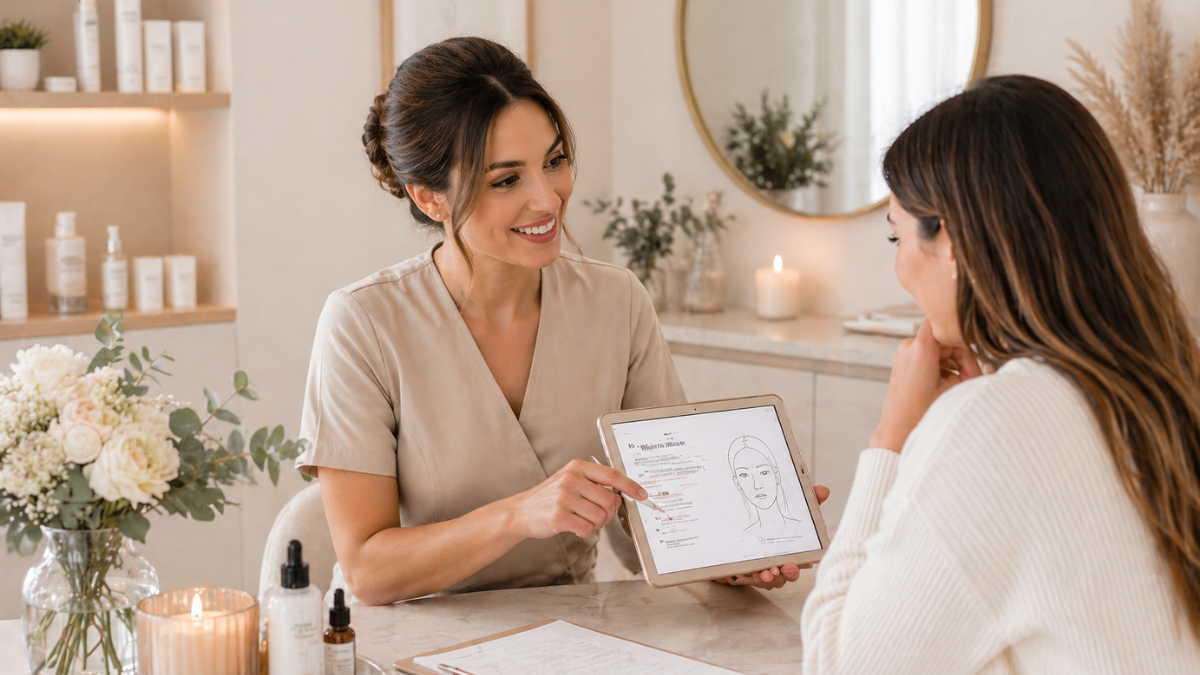
Clients notice when the admin side feels messy. They notice when forms are hidden, sent late, or awkward to complete. And they definitely notice when they’re handed a random clipboard five minutes before a treatment that clearly needed a proper consultation.
A beauty FAQ page is a good place to explain the process simply:
How do I complete my forms?
If your treatment requires forms, we’ll send them digitally before your appointment. You can complete them on your phone, tablet, or computer, so everything is done before you arrive whenever possible.
That kind of answer works because it reduces uncertainty fast.
Glow Forms supports this exact setup with mobile-optimised digital forms, brand colours and logos, QR code sharing, email links, website embeds, and a searchable client record system that keeps completed forms organised in one place. That means the FAQ answer is not just nice wording on a page. It can reflect a smoother system behind the scenes.
Answer what clients mean, not just what they ask
Here’s the subtle part.
Clients often phrase a question one way while meaning something slightly different.
“Do I need to arrive early?” often means: “Is your check-in process annoying?”
“Do you keep records?” can mean: “Are you actually professional?”
“Can I do this on my phone?” really means: “Please don’t make this awkward.”
Your FAQ page gets better when you answer the underlying concern too.
For example:
Will the forms work on my phone?
Yes. Our forms are mobile-friendly, so you can complete them easily on your phone without downloading anything or struggling with awkward PDFs.
Now you’re answering the real worry, not just the literal question.
Skip the fake FAQ filler
I’d skip these unless they genuinely help:
“Why choose us?”
“Are you the best salon in the area?”
“Do you offer high-quality services?”
“How can I contact you?”
That’s not an FAQ page. That’s marketing copy wearing a fake moustache.
Use the space for real friction points instead. The questions that stop bookings, delay check-ins, or create back-and-forth you answer every week.
That’s the good stuff.
A simple beauty FAQ structure that works
If you want a clean version, keep it like this:
Booking
Answer how to book, whether consultations are needed, whether deposits apply, and how patch tests work.
Appointment prep
Answer what clients should do before arriving, whether they should come makeup-free, when they should arrive, and anything service-specific.
Forms
Answer when forms are sent, how to complete them, whether they work on mobile, and why some treatments require them.
Policies
Answer lateness, cancellations, no-shows, minors, guests, and payment methods.
Aftercare and follow-up
Answer where aftercare comes from, whether follow-up appointments are needed, and what clients should expect after treatment.
That is usually enough.
Not tiny. Not bloated. Just useful.
What a helpful FAQ page actually does for your business
It saves time, obviously. Fewer repetitive messages. Fewer confused arrivals. Fewer people asking the same thing three different ways.
But it also does something quieter.
It makes your business feel more put together.
That’s a big deal in beauty. Clients are paying attention to the small signals. A clear FAQ page, a clean booking process, branded forms, proper records, and mobile-friendly check-ins all add up to one impression: this place knows what it’s doing.
Glow Forms leans into that outcome on purpose. The platform is positioned around helping beauty professionals look more organised, more professional, and more trustworthy while keeping client records secure, searchable, and easy to manage.
And that kind of confidence starts before the appointment.
Sometimes it starts on one quiet little FAQ page that finally answers the question properly.