What Makes Clients Choose the More Expensive Option
A client says, “I’ll just go with the basic one.”
And sometimes that’s completely fine.
But sometimes you know they’re choosing the cheaper option for the wrong reason. Not because it’s the best fit. Because they’re unsure. Because the difference wasn’t clear. Because the premium service sounded like a bigger price tag with no real picture attached to it.
That part matters more than most salon owners think.
Clients rarely choose the more expensive option because they got dazzled by a sales pitch. They choose it when it feels like the better decision. Safer. Smarter. More aligned with what they actually want.
That’s the shift.
Price matters. But clarity usually matters first.
When a client hesitates between two options, the problem often isn’t the number.
It’s the fog around the number.
If your basic facial is £55 and your advanced one is £85, the client is doing a quick mental check: “What exactly am I getting for the extra £30?”
If the answer is fuzzy, they protect themselves by going cheaper.
That’s normal.
People spend more when the value feels concrete. Not vague. Not padded with fancy wording. Concrete.
So instead of saying:
“this one is more advanced”
or
“this package gives better results”
show the real difference.
Try this instead:
the basic option is for maintenance
the more expensive option includes extra treatment time
it addresses a specific concern more directly
it includes aftercare or a more tailored plan
it may reduce the need for guesswork later
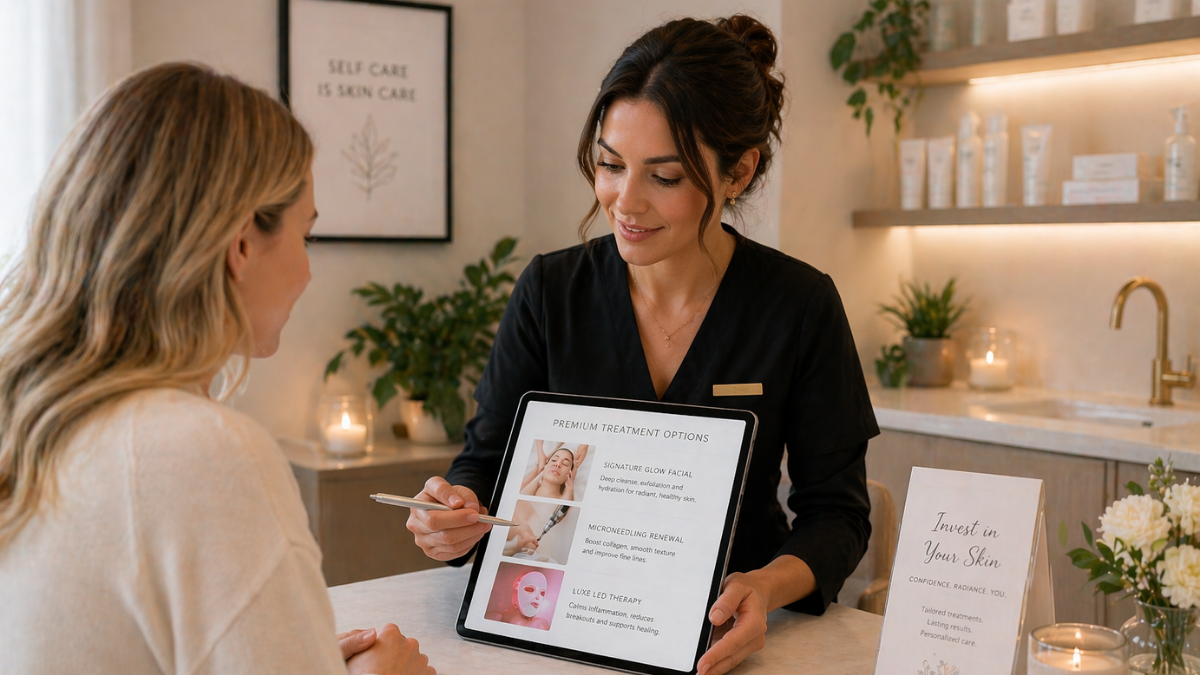
Now the client can actually compare.
And that’s when better decisions happen.
People buy confidence, not just treatments
Here’s where it gets weird: clients often spend more when they feel less pressured.
The hard sell usually backfires. It makes people defensive. They start looking for the exit. Or they nod politely and then book the cheapest thing just to regain control.
But when you explain the premium option calmly and specifically, you create something better than persuasion.
You create confidence.
Confidence sounds like this:
“This option makes more sense for you because your skin is reactive and we’d have more time to work carefully.”
Or:
“You can absolutely book the smaller service, but because you want longer-lasting results, I think this one is the better fit.”
That kind of recommendation lands differently. It feels guided, not pushed.
Clients pay more when they trust that you’re helping them choose well.
The more expensive option has to feel easier, not just better
This is the part people skip.
A premium service should not feel like extra confusion.
If the high-ticket option comes with more explanation, more paperwork, more uncertainty, and a messier booking process, some clients will quietly downgrade just to avoid the friction.
That’s one reason the client experience around forms and consultations matters more than it seems. Glow Forms is built specifically for beauty professionals to make digital intake, consent, consultation, medical history, and treatment record forms feel simple, branded, and easy to complete on phone, tablet, or desktop. Instead of paper forms, clunky PDFs, or scattered records, salons can send everything by link, email, QR code, or website button and keep it organised in one place.
That matters because premium clients do not want a premium service wrapped in a scrappy process.
If they are paying more, they want the whole experience to feel more professional from the start.
And honestly, that’s fair.
Clients spend more when the risk feels lower
Most expensive options feel risky at first.
Not because clients assume you’re overcharging. Because more money raises the stakes.
They start wondering:
What if it’s not worth it?
What if I don’t like the result?
What if I book the wrong thing?
What if I’m agreeing to something I don’t fully understand?
That’s why trust signals matter so much.
Clear consultation. Clean branding. Calm communication. Good records. Obvious professionalism.
Glow Forms leans into exactly those outcomes: a stronger first impression, better records, a more professional image, and more peace of mind when it comes to client data and treatment history. The platform is designed for salons, spas, estheticians, nail techs, lash artists, PMU artists, massage therapists, and similar beauty businesses that want to look organised without wrestling with generic tools.
That kind of setup reduces invisible risk.
And when the risk feels lower, spending more feels easier.
Specific outcomes beat fancy language
Let’s be honest. “Luxury” has become one of those words that means almost nothing on its own.
Clients do not automatically pay more because a treatment sounds premium.
They pay more when they can picture the outcome.
A stronger way to position the upgrade is to connect it to a result the client already cares about.
For example:
A lash client may spend more for better retention before a holiday.
A facial client may spend more for a treatment aimed at a specific breakout pattern or sensitivity issue.
A PMU client may spend more for a more detailed consultation and long-term treatment planning.
A regular nail client may upgrade because the more expensive option lasts longer through work, travel, or an event.
That is real-world value.
Not fluff. Not “elevated experience.” Actual relevance.
Timing changes everything
There’s a good moment to introduce the more expensive option, and a bad one.
Bad moment: while the client is confused, rushed, or already halfway through paying.
Good moment: when you understand what they want and can connect the better option to that goal.
That usually means the premium option should come up during consultation, not as a random add-on thrown in at the last second.
If a client says, “I want something natural but I also want it to last,” that’s your opening.
If a client says, “I’ve had reactions before,” that’s your opening.
If a client says, “I don’t want to keep coming back to fix this,” that’s definitely your opening.
You’re not forcing a bigger sale. You’re matching the recommendation to the problem they just handed you.
That’s why good consultations make more money than clever scripts.
The cheaper option must still be treated with respect
This sounds unrelated, but it isn’t.
Clients trust premium recommendations more when they can feel you’d still treat them well if they choose less.
The moment someone senses that the cheaper option makes them a less valuable client, trust drops. And once trust drops, premium sales usually disappear with it.
So present both options cleanly.
Explain the cheaper one honestly. Explain the more expensive one honestly. Then recommend the one that fits best.
That balance is what makes a client think, “Okay, this person knows what they’re doing.”
Presentation quietly changes what people pick
Same service. Same price. Different presentation. Different result.
A premium option tends to convert better when:
the name is clear, not overcomplicated
the difference from the base option is obvious
the booking and consultation process feels smooth
the salon branding looks professional
the client doesn’t have to chase information
Glow Forms supports that smoother presentation with branded forms, logo and colour matching, mobile-friendly completion, and searchable digital records. It is positioned very intentionally around making beauty businesses feel more polished, more organised, and easier to trust without needing an agency or IT help.
And yes, clients notice these things.
Maybe not consciously. But they notice.
A simple example from real salon life
Let’s say a new brow client is deciding between a standard appointment and a more expensive shaping and mapping service.
If you say, “This one is our premium option,” that does almost nothing.
If you say, “The standard appointment is great if you already know the shape you like. The shaping and mapping option is better if you want more time spent designing the right brow shape for your face before we start,” now the higher price makes sense.
One sounds expensive.
The other sounds useful.
That difference is the whole game.
What actually makes people choose the higher option
Usually, it comes down to a few quiet things working together:
the value is specific
the recommendation feels personal
the experience feels professional
the risk feels lower
the client understands why it fits them better
That’s it.
Not manipulation. Not pressure. Not “premium language” copied from somebody else’s website.
Just clarity and trust, stacked properly.
And once you see that, the sales part gets a lot less awkward.
Because you stop trying to talk clients into spending more.
You start helping them see when the better option is actually better.